Sunday, July 17, 2016

FUTURE OF INTERNAL COMBUSTION ENGINE (CONT'D) 

FUTURE OF INTERNAL COMBUSTION ENGINE (CONT'D)
This technology, abbreviated as HCCI, is essentially a combination of the operating principles of a gas engine and a diesel. When high power is required, an HCCI engine operates like a conventional gasoline engine, with combustion initiated by a spark plug. At more modest loads, it operates more like a diesel, with combustion initiated simply by the pressure and heat of compression.
In a diesel engine, combustion starts when the fuel is injected with the piston near the top of the compression stroke, and the combustion is controlled by the speed at which the fuel is injected. With HCCI, however, the fuel has already been injected and mixed with the air before the compression stroke begins.
Since compression alone initiates combustion, it’s more of a big bang than even a diesel’s hard-edged power stroke. Making the engine sturdy enough to avoid blowing apart makes an HCCI at least as heavy as a diesel. The key is achieving sufficient combustion control so that the HCCI cycle can be used over as wide a speed and load range as possible to reap the efficiency benefits.
One way to extend the HCCI mode is to employ a variable compression ratio, which is what Mercedes has done on its experimental Dies-Otto engine. But other engineers, such as GM’s Hancock, would like to avoid that complication. “To make HCCI work, we need very good control of the combustion process with a faster engine-control computer and combustion-pressure feedback.”
It all sounds complicated, but the payoff can be a 20-percent improvement in fuel economy without the particulate traps and the NOx catalysts that diesels need. That’s enough to sustain interest among the major players. Hancock guesses that HCCI might make it into production by the end of this decade, perhaps as an efficient engine for a plug-in hybrid because it only needs to run over a small rpm band to power a generator.
Turning off an engine when stopped at a light can definitely save fuel. It’s easy to program an engine-control computer to shut down an engine when the vehicle speed drops to zero and restart it when the driver removes his foot from the brake pedal. The starter and the battery might need to be beefed up to withstand more frequent use, but that’s no technical challenge.
Mazda has come up with a simpler method of accomplishing the stop-start feat. In its system, called i-stop, the computer stops the engine when one piston is just past the top of the compression stroke. To restart, fuel is injected into the cylinder, the spark plug is fired, and the engine is instantly running again.
Unfortunately, while these systems might save as much as five percent of fuel consumption in an urban setting, the EPA’s test cycles demonstrate only a one-percent benefit, due to limited idle times. As a result, most manufacturers are reluctant to invest in a technology that doesn’t do much to help them meet their CAFE goals, no matter the real-world benefit.
One of the downsides of corn-based ethanol is that current flex-fuel engines generally aren’t taking full advantage of E85’s 95- octane rating. But it’s easy to envision a second-generation DI turbo engine that runs higher boost pressure when burning E85. Such an engine could be half the size of a current naturally aspirated powerplant, with substantially higher fuel economy. And when fueled with pure gasoline, the computer would simply dial back the boost. The engine would lose some power but without compromising durability or fuel efficiency.
A more radical way to harness ethanol’s higher octane rating is the “ethanol boosting system” (EBS) being worked on by several MIT professors as well as Neil Ressler, Ford’s former top technology executive.
The concept is simple. Start with a DI-turbo engine and add a conventional port-fuel-injection system to it. Then add a second, small fuel tank and fill that one with E85. During modest loads, the engine runs on gasoline and port injection. But when you call for more power and the boost comes up, the DI system injects E85. Not only does E85 have a higher octane rating than gasoline, it also has more cooling effect. This allows safe operation above 20 psi of boost.
Ford has shown serious interest in the project. For a pickup application, a twin-turbo 5.0-liter EBS engine might replace the 6.7-liter diesel in the Super Duty truck. It would develop the same power and torque, achieve similar fuel efficiency, and be cheaper to build because it doesn’t need any of the diesel’s expensive exhaust after-treatment.
In normal use, E85 consumption would be less than 10 percent of the gasoline consumption. Therefore, you save a lot of gas while consuming only a little ethanol. The EBS engine seems technically sound and has already survived preliminary tests. We expect that it will make it into production in some form within the next five years.
Imaginative new engine concepts are a dime a dozen. Our technical director usually keeps a fat file full of them labeled “crackpot engines.” Most never even reach the prototype stage. And even the ones that do get built generally flame out due to problems involving durability, construction complexity, or efficiency. The very few that get beyond that stage face an uphill battle with automakers who have billions invested in building conventional engines of proven reliability and performance.
One of the few new engine concepts that looks promising is the OPOC two-stroke from EcoMotors. OPOC stands for “opposed piston opposed cylinder.” To visualize the engine, start with a horizontally opposed four-cylinder like the Subaru Legacy’s. Then extend the cylinders and lose the cylinder heads to make room for a second set of pistons within each cylinder that move opposite of the conventional pistons. Long connecting rods transfer the motion of these additional pistons to throws on the crankshaft.
As in a typical two-stroke, breathing occurs through ports in the sides of the cylinders. But in the OPOC engine, the intake and exhaust ports are at opposite ends of the cylinders. As the pistons move, the exhausts are uncovered before the intakes and turbochargers blow air through the cylinders to push out the exhaust gas and fill them with clean air. Since the engine needs positive pressure to do this, the turbochargers have electric motors to power them at low rpm when exhaust energy is low.
Though the first OPOC engines are ­diesels, the concept can also work with gasoline. Either way, the direct-fuel injector is in the middle of the cylinder where the two ­piston crowns almost meet, and that’s where a spark plug would be in a gas version.
If the OPOC’s design seems radical, it has solid people backing it. The engine designer is Peter Hofbauer, Volkswagen’s former chief engine engineer. The Eco­Motors CEO is Don Runkle, a former top executive at Delphi and GM. The president is John Coletti, the legendary former boss of Ford’s SVT division. And exhaust-maker extraordinaire, Alex Borla, is on the board of directors. Much of the company’s funding comes from Vinod Khosla, a Silicon Valley mega-investor.
Thus far, prototypes of the OPOC engine have delivered 12-to-15-percent better efficiency than conventional piston engines, due primarily to the absence of cylinder heads, eliminating a large surface through which the heat of combustion is lost to the coolant, and the absence of the valvetrain, which reduces friction by some 40 percent.
Furthermore, because each two- cylinder, four-piston module is perfectly balanced, it is possible with a four-cylinder version of the engine to completely decouple one cylinder pair under light loads. This not only reduces pumping losses but also completely eliminates the friction from the disabled cylinder, improving fuel efficiency by an additional 15 percent.
Thus far, Coletti says that there are no obvious problems: “Emissions look good, and so does oil consumption. There’s nothing that has me worried.” Runkle adds that due to the fewer parts—no heads or valvetrain—the engine should be 20-percent cheaper to build than a modern V-6. “We’re working on two engine families. The EM100d is a diesel with a 100-millimeter bore developing 325 horsepower, and the EM65ff has a 65-millimeter bore and makes about 75 horsepower in two-cylinder form on gasoline.”
The engine is years away from production. For a small, growing company without a huge investment in conventional engines—think Chinese or Indian—the OPOC engine is attractive. A military contract would also pave the way toward civilian acceptability.
As mentioned, being able to change a running engine’s compression ratio would help to make HCCI work. Most such schemes involve somehow changing either the stroke of an engine’s piston or the distance from the crankshaft to the combustion chamber. Both approaches are mechanically problematic. The clever engineers at Lotus have come up with a simpler way to change an engine’s compression. They’ve created a cylinder head that has a movable section—they call it a puck—that can extend into the combustion chamber. With the puck fully retracted, the compression ratio is 10:1. When extended into the head, it reduces the combustion-chamber volume, thereby increasing the ratio to as high as 40:1. There’s room for this puck because the engine, which Lotus calls “Omnivore,” is a two-stroke without any valves. Instead, intake and exhaust flows occur through ports in the cylinder walls. Fuel injection occurs directly into the cylinder via an air-assisted system developed by Orbital for a different two-stroke engine the company has been working on for about 30 years. Lotus claims that the Omnivore engine can operate extensively in HCCI mode and achieves a 10-percent fuel-efficiency gain over current DI-gasoline engines. Due to the variable compression ratio, it can also operate on a variety of fuels, hence its name. At this point, the engine is only a single-cylinder research project. Clever, but whether it will advance further remains to be seen.

The Future of the Internal Combustion Engine

The Future of the Internal-Combustion Engine

Despite the green hype, internal-combustion engines will keep powering vehicles for the foreseeable future


Carlos Ghosn, the CEO of Nissan and Renault, has proclaimed that battery-powered vehicles will account for 10 percent of global new-car sales by 2020. Mr. Ghosn, of course, is planning to introduce at least four electric cars in the next three years. Independent analysts, however, such as Tim Urquhart of IHS Global Insight, believe that battery-powered vehicles will remain at less than one percent of the new-car mix in 2020.
The fact is that electric vehicles are prohibitively expensive today—the battery alone in an electric car can cost $20,000—and will remain so for some time. Moreover, electric vehicles are unproven in the real world. If carmakers are going to bet their futures on this technology, they will do so very gradually. Even under Ghosn’s optimistic view, internal-combustion (IC) engines will power 90 percent of 2020 vehicles. Koei Saga, Toyota’s boss of advanced technology (including electric cars), goes further: “In my personal view, I think we will never abandon the internal-combustion engine.”
But they won’t be the same IC engines that power vehicles today. With federal fuel-economy standards getting tougher by 35 percent over the next five years, IC efficiency must improve dramatically—if not, we’ll all be forced to drive econoboxes.
After speaking with key powertrain engineers and some independent inventors, we’ve examined some of the technologies that can achieve this improved efficiency.

Spraying fuel directly into a gasoline engine’s combustion chambers instead of its intake ports isn’t a new idea—the World War II ME109 German fighter plane used it. The Japanese-market Mitsubishi Galant was the first car to combine direct injection with computer-controlled injectors in 1996. Direct injection (DI) costs more than port injection because the fuel is sprayed at 1500–3000 psi rather than 50–100 psi, and the injectors must withstand the pressure and heat of combustion.
But DI has a key benefit: By injecting fuel directly into the cylinder during the compression stroke, the cooling effect of the vaporizing fuel doesn’t dissipate before the spark plug fires. As a result, the engine is more resistant to detonation—a premature and near-explosive burning of the fuel, producing a knocking sound and pounding the pistons with pressure and heat—and can therefore operate with a higher compression ratio—about 12:1 instead of 10.5:1. That alone improves fuel economy by two to three percent.
And DI also offers the possibility of lean combustion because the fuel spray can be oriented so that there is always a combustible mixture near the spark plug. That could yield five percent more efficiency.
Several European carmakers are already using this lean-burn strategy. Unfortunately, lean combustion causes higher tailpipe emissions of NOx (oxides of nitrogen), which run afoul of America’s tighter limits. Catalysts that can solve this problem don’t like the high sulfur content in American gasoline. New catalysts promise to reduce emissions. Meanwhile, expect direct injection to become universal by 2020.

Modern engines achieve power levels that we could only dream about 20 years ago. The downside is that during routine driving, most engines are loafing—and 300-hp engines are inefficient when they’re only putting out the 30 ponies needed to push an average sedan down the highway. When an engine’s throttle is barely cracked open, there’s a strong vacuum in the intake manifold. During the intake stroke, as the pistons suck against this vacuum, efficiency suffers.
The classic solution to this problem is to make an engine smaller. A small engine works harder, running with less vacuum, and is consequently more efficient. But small engines make less power than big ones.
To make big-engine power with small-engine fuel economy, many companies are turning to smaller engines with turbochargers, direct fuel injection, and variable valve timing. These three technologies work together to their combined benefit.
Forcing additional air into an engine’s combustion chambers with a turbocharger definitely boosts power; car manufacturers have been doing this for years. But in the past, in order to avoid harmful detonation, turbocharged engines needed lower compression ratios, which compromised efficiency.
As we’ve seen, direct fuel injection helps solve this problem by cooling the intake charge to minimize detonation. Second, if the variable valve timing extends the time when both the intake and the exhaust valves are open, the turbocharger can blow fresh air through the cylinder to completely remove the hot leftover gases from the previous combustion cycle. And since the injectors squirt fuel only after the valves close, none of it escapes through the exhaust valve.
The first engine in America with all three of these elements was the base 2.0-liter four-cylinder in the 2006 Audi A4. It had a 10.5:1 compression ratio—as high as many naturally aspirated engines—despite a peak boost pressure of 11.6 psi. It produced 200 horsepower and 207 pound-feet of torque.
Ford’s EcoBoost system is nothing more than direct injection and turbocharging. Dan Kapp, Ford’s director of advanced powertrain engineering, says that this technology will spread across the company’s cars and trucks. “Nothing else delivers double-digit improvements in fuel efficiency at a reasonable cost.”
In the future, Ford expects to replace its 5.4-liter V-8 with a 3.5-liter EcoBoost V-6; its 3.5-liter V-6 with a 2.2-liter EcoBoost inline-four; and its 2.5-liter inline-four with a 1.6-liter EcoBoost inline-four. In each downsizing, peak power should be similar, low-end torque should be about 30 percent greater, and fuel economy should be 10-to-20 percent higher. The only downside will be an added charge of $1000 or so to the price of DI-turbo vehicles to pay for the additional hardware.
BMW, Mercedes, Toyota, and Volkswagen are planning similar engines—some using superchargers instead of turbochargers. Turbocharging with direct injection will continue to expand.
Later in the decade, we will see a second generation of these engines, using higher boost pressures. This will allow further engine downsizing to achieve an additional 10-percent efficiency improvement.
Making this happen will require cooled exhaust-gas recirculation to control detonation and either staged or variable-geometry turbos to limit customary lag. Those technologies are already in use on diesel engines, but a gas engine’s higher exhaust temperatures pose durability problems that must be solved before carmakers can deploy these technologies.

Another way to improve the efficiency of a big engine is to turn off some of its cylinders. Since the throttle must be opened farther to get the same power from the remaining cylinders, intake-manifold vacuum goes down and efficiency goes up.
In real-world driving, this can produce a fuel-economy improvement of five percent, at a fairly low cost. The technology is particularly cost effective on pushrod, two-valve engines, which is why we’ve seen variable displacement on GM and Chrysler V-8s.
Honda uses variable displacement on its 24-valve V-6 engines, but the additional hardware to close the multiplicity of valves adds cost. Moreover, shutting off some cylinders on a V-6 generates more vibration and noise problems than it does with a V-8 because V-6s have coarser firing impulses and poorer inherent balance. The active engine mounts and variable intake manifolds needed to solve these problems add further costs.

The simplest implementation of variable valve timing started about 25 years ago, using a two-position advance or retard of either an engine’s intake or exhaust camshaft to better match the engine’s operating conditions. Today, most four-valve-per-cylinder DOHC engines have continuously variable phasing on both the intake and the exhaust camshafts.
About 20 years ago, Honda introduced a more elaborate approach with its VTEC system, which shifted between two (and later, three) separate sets of cam lobes—one for high-speed operation and one for low. VTEC can also simply turn off one of a cylinder’s two intake valves under light loads. In 2001, BMW went a step further with its Valvetronic system, which can continuously vary the opening stroke of the intake valves to optimize engine power and efficiency. Furthermore, this extensive control of the intake valves serves to replace a throttle plate, which eliminates vacuum and therefore reduces pumping losses.
Though they provide efficiency benefits, variable-lift systems are complex and expensive. Development continues on purely electronic systems that could replace camshafts and simply open and close an engine’s valves according to a computer. But electronic valve-opening mechanisms are also costly and consume significant power. GM Powertrain VP Dan Hancock suggests that a two-stage valve-lift mechanism can deliver 90 percent of the benefits of fully variable lift. Moreover, Ford’s Kapp says that the benefits of variable valve lift are limited when combined with EcoBoost (DI turbo).
On the other hand, BMW, with its latest single-turbo, direct-injection 3.0-liter inline-six (N55) that’s replacing the twin-turbo (N54) across the lineup, has done just that by adding Valvetronic to its DI-turbo configuration. Combined with the move from a six-speed automatic to an eight-speed, the change is said to provide 10 percent more miles per gallon.
Perhaps the answer will be Fiat’s Multiair system, a hydraulically operated variable-lift design that is far less complex than mechanical systems such as BMW’s. Expect to soon see Multiair on upcoming Chrysler vehicles.F

Saturday, July 16, 2016

Engines of Future


Over the past several years, road transportation has seen some significant advances in what are considered alternative technologies. Energy storage, electric drive systems, and fuel cell technology all seem to be poised to find a significant place in the automotive marketplace.
But it would be a mistake to believe that such technologies will completely sweep aside what has come before. Instead, the internal combustion engine will continue to be integral to the transportation of people and goods for the foreseeable future.
That is not to say that things will stay as they are now. The engine is undergoing a significant evolution of its own, as new fuel economy and emissions standards in the light-duty and heavy-duty sectors push the development of new technologies on an unprecedented scale toward the theoretical limits of engine operation. Coupled with continuing research into fundamental engine processes, the introduction of affordable high-performance computing, and the adoption of advanced manufacturing techniques throughout industry, those new technologies are leading to potentially disruptive opportunities for the introduction of engines with extraordinarily high efficiencies. How these new engines perform and how they will be integrated into new vehicle architectures will be the story of personal mobility for this half of the 21st century.
From my position at Oak Ridge National Laboratory, I have been able to see the intersection of knowledge discovery, advanced engine and vehicle technology development, and the use of one-of-a-kind computing resources. Although the public tends to think of automobile and engine research as a purely private-sector concern, my colleagues and I at ORNL are helping to realize the full efficiency potential of internal combustion engines.
The internal combustion engine has seen a remarkable evolution over the past century. Before 1970 the evolution of engine design was driven by a quest for performance and an increase in octane in the fuel supply. Since then, however, the imperative was the need to meet new emissions and fuel economy regulations.
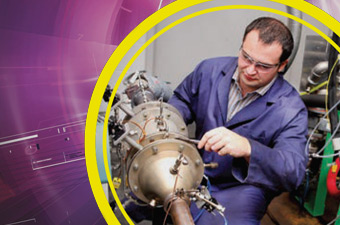
Vitaly Prikhodko of ORNL’s Fuels, Engines and Emissions Research studying advanced catalysts which are used to reduce vehicle pollution. Image: ORNL
Internal combustion engine efficiency has historically been limited more by the state of technology than innovation. As an example, the potential of technologies such as gasoline direct injection were known and attempted in production more than 50 years ago, but direct injection has only become widely available in production within the last decade and now makes up approximately 38 percent of new light-duty vehicle sales. Another example is low-temperature combustion modes such as homogeneous charge compression ignition combustion—in which fuel and air are injected during the intake stroke and then compressed until the entire mixture reacts spontaneously—which were demonstrated in a laboratory more than 30 years ago but are still many years away from market introduction.
Game-changing advances in recent years are improvements in engine technologies, sensors, and onboard computing power. This combination of technologies will enable unprecedented control of the combustion process, which in turn will enable real-world implementations of low-temperature combustion and other advanced strategies as well as improved robustness and fuel flexibility. In fact, technological advances are blurring our historical distinction between spark-ignition and compression-ignition engines; we will see new engine concepts that blend the best characteristics of both engine types to push the boundaries of efficiency while meeting stringent emissions regulations worldwide.
The push toward higher-efficiency engines will alter exhaust temperatures and chemistry and may create challenges for emission control technologies.
For example, new higher-efficiency engines will have lower exhaust temperatures, due to more efficient work extraction at the piston. Lower exhaust temperatures will, in turn, require the development of new emission control technologies, which must not only be effective at low temperatures but also must survive high exhaust temperatures encountered under high load conditions.

Who really invented the first automobile?

Siegfried Marcus - Automotive


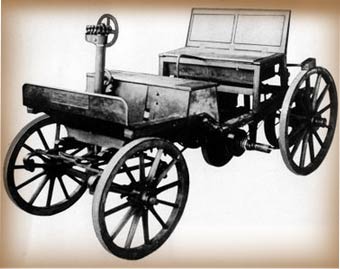
Who really  invented the first automobile? It all depends on how you define words like "automobile," "first," and "invent." But if the question is, who was the first to gear a combustion engine to a set of four wheels to make it go, the answer must be Austrian inventor Siegfried Marcus.
Marcus finished his first car sometime between 1864 and 1870 – some 15 years before the better-remembered efforts of Karl Benz andGottlieb Daimler. His primordial design lacked numerous now-standard features such as brakes, steering, and seats, to name a few. But what it did have – an internal combustion engine, a carburetor and four wheels – would provide the basic DNA of gasoline-powered automobiles for the next 140 years and counting.
Marcus made his mark as an inventor of electrical systems, telegraph equipment, and scientific instruments. Born in Germany in 1831, he was already working toward an engineering career by age 12. A machine-shop apprenticeship paved the way to a position in the telegraph industry, and his ideas for improved telegraphic relay systems earned wide international acclaim. He was also known for inventing the familiar T-handled plunger apparatus used to detonate explosives in mining and other applications. These breakthroughs gave him the financial wherewithal to build his own research laboratory in the 1860s.
Self-propelled transportation was an intellectual rather than commercial enterprise for Marcus. He pursued his many areas of technological interest, including the use of liquid fuels for lighting applications. When he realized the explosive force that occurred when he used sparks to ignite an atomized petroleum-and-air mixture, he quickly realized the potential to harness that power to do work. His two-cycle internal combustion engine was born.
Siegfried Marcus - Automotive
Siegfried Marcus finished his first car some 15 years before the better-remembered efforts of Karl Benz and Gottlieb Daimler.
Most inventors working on alternative engine designs and fuel sources in those days were focused on big established markets for steam power such as boat motors, pumps, factory machinery, and so forth. But Marcus took note of early steam cars and saw an opportunity for his engine. For his first attempt, he mounted the motor on a four-wheeled cart and connected it to the two back wheels. It had the ultimate manual transmission – literally a hefty helper who lifted the back end up to hand-start the car by spinning a rear wheel. When ready to roll, the assistant lowered the car and off it went – for a history-making 500 feet.
Marcus would spend the next decade or more tinkering with his engine in his spare time. During this period he patented his ideas for a magneto ignition system, a rheostat, and other inventions. Marcus's next car, debuting in about 1888, was a quantum improvement over his first crude effort.
Revolutionary features included a four-cycle, gasoline-powered engine, Marcus's novel carburetor design, and his magneto ignition. The car was said to reach a top speed of 10 mph.
His later models were refined with steering, brakes, a clutch, and other features that simply hadn't been conceived of when Marcus first hitched his engine to a buggy. None of these later models still exists, but his landmark second car survives today and is owned by the Austrian Automobile Club – the oldest gasoline-poweredinternal combustion car on the planet, as far as anyone knows.
Marcus died in 1898. During his lifetime, he was widely considered (and formal honured as) the originator of the motorcar. But his place in history was all but erased during the German annexation of Austria in 1938. Because Marcus was a Jew, the Nazi propaganda office ordered his work to be destroyed, his name expunged from future textbooks, and his public memorials removed.
They largely succeeded in writing him out of history. Exact dates for his key innovations are still difficult to nail down. But there is no obfuscating the fact that this ahead-of-his-time engineer and inventor built four progressively sophisticated combustion-engine cars over a 10-to-15-year span, and many of his inventions have found their way into the cars of today.