Over the past several years, road transportation has seen some significant advances in what are considered alternative technologies. Energy storage, electric drive systems, and fuel cell technology all seem to be poised to find a significant place in the automotive marketplace.
But it would be a mistake to believe that such technologies will completely sweep aside what has come before. Instead, the internal combustion engine will continue to be integral to the transportation of people and goods for the foreseeable future.
That is not to say that things will stay as they are now. The engine is undergoing a significant evolution of its own, as new fuel economy and emissions standards in the light-duty and heavy-duty sectors push the development of new technologies on an unprecedented scale toward the theoretical limits of engine operation. Coupled with continuing research into fundamental engine processes, the introduction of affordable high-performance computing, and the adoption of advanced manufacturing techniques throughout industry, those new technologies are leading to potentially disruptive opportunities for the introduction of engines with extraordinarily high efficiencies. How these new engines perform and how they will be integrated into new vehicle architectures will be the story of personal mobility for this half of the 21st century.
From my position at Oak Ridge National Laboratory, I have been able to see the intersection of knowledge discovery, advanced engine and vehicle technology development, and the use of one-of-a-kind computing resources. Although the public tends to think of automobile and engine research as a purely private-sector concern, my colleagues and I at ORNL are helping to realize the full efficiency potential of internal combustion engines.
The internal combustion engine has seen a remarkable evolution over the past century. Before 1970 the evolution of engine design was driven by a quest for performance and an increase in octane in the fuel supply. Since then, however, the imperative was the need to meet new emissions and fuel economy regulations.
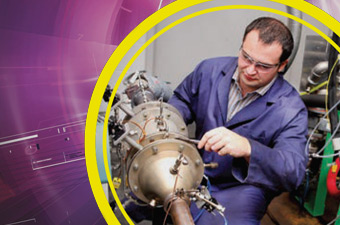
Vitaly Prikhodko of ORNL’s Fuels, Engines and Emissions Research studying advanced catalysts which are used to reduce vehicle pollution. Image: ORNL
Internal combustion engine efficiency has historically been limited more by the state of technology than innovation. As an example, the potential of technologies such as gasoline direct injection were known and attempted in production more than 50 years ago, but direct injection has only become widely available in production within the last decade and now makes up approximately 38 percent of new light-duty vehicle sales. Another example is low-temperature combustion modes such as homogeneous charge compression ignition combustion—in which fuel and air are injected during the intake stroke and then compressed until the entire mixture reacts spontaneously—which were demonstrated in a laboratory more than 30 years ago but are still many years away from market introduction.
Game-changing advances in recent years are improvements in engine technologies, sensors, and onboard computing power. This combination of technologies will enable unprecedented control of the combustion process, which in turn will enable real-world implementations of low-temperature combustion and other advanced strategies as well as improved robustness and fuel flexibility. In fact, technological advances are blurring our historical distinction between spark-ignition and compression-ignition engines; we will see new engine concepts that blend the best characteristics of both engine types to push the boundaries of efficiency while meeting stringent emissions regulations worldwide.
The push toward higher-efficiency engines will alter exhaust temperatures and chemistry and may create challenges for emission control technologies.
For example, new higher-efficiency engines will have lower exhaust temperatures, due to more efficient work extraction at the piston. Lower exhaust temperatures will, in turn, require the development of new emission control technologies, which must not only be effective at low temperatures but also must survive high exhaust temperatures encountered under high load conditions.

No comments:
Post a Comment